
Tune Up or Time Out? Your Car Maintenance Schedule

Why Your Car Maintenance Schedule Is the Most Important Document in Your Glove Box
A solid car maintenance schedule is the difference between a vehicle that runs reliably for 200,000 miles and one that leaves you stranded on the side of the road. Most manufacturers build their recommendations around a simple framework — check, replace, or inspect key components at 30,000, 60,000, and 90,000 miles.
Here's a quick look at the core intervals every driver should know:
Core Car Maintenance Schedule at a Glance
- Every 5,000–7,500 miles — Engine oil and filter change (synthetic oil)
- Every 6,000–8,000 miles — Tire rotation
- Every 15,000–30,000 miles — Engine air filter and cabin air filter
- Every 20,000–45,000 miles — Brake fluid replacement
- 30,000 miles — Fuel filter, inspect belts and hoses
- 60,000 miles — Coolant flush, transmission fluid, brake pads
- 75,000–90,000 miles — Timing belt, spark plugs, power steering fluid
- Every 3–5 years — Battery replacement
Always check your owner's manual first — these are general guidelines, and your vehicle may have different requirements.
Skipping scheduled maintenance doesn't just risk a breakdown. It quietly chips away at fuel efficiency, safety, and resale value — often costing far more in repairs than the routine service ever would have.
I'm Ben Toscano, and I've spent over 20 years helping Omaha families stay ahead of exactly these issues through honest, straightforward maintenance at Gateway Auto — because a clear car maintenance schedule is one of the simplest ways to protect what your family depends on every day. Let's walk through what that schedule actually looks like, and how to make it work for the way you drive.
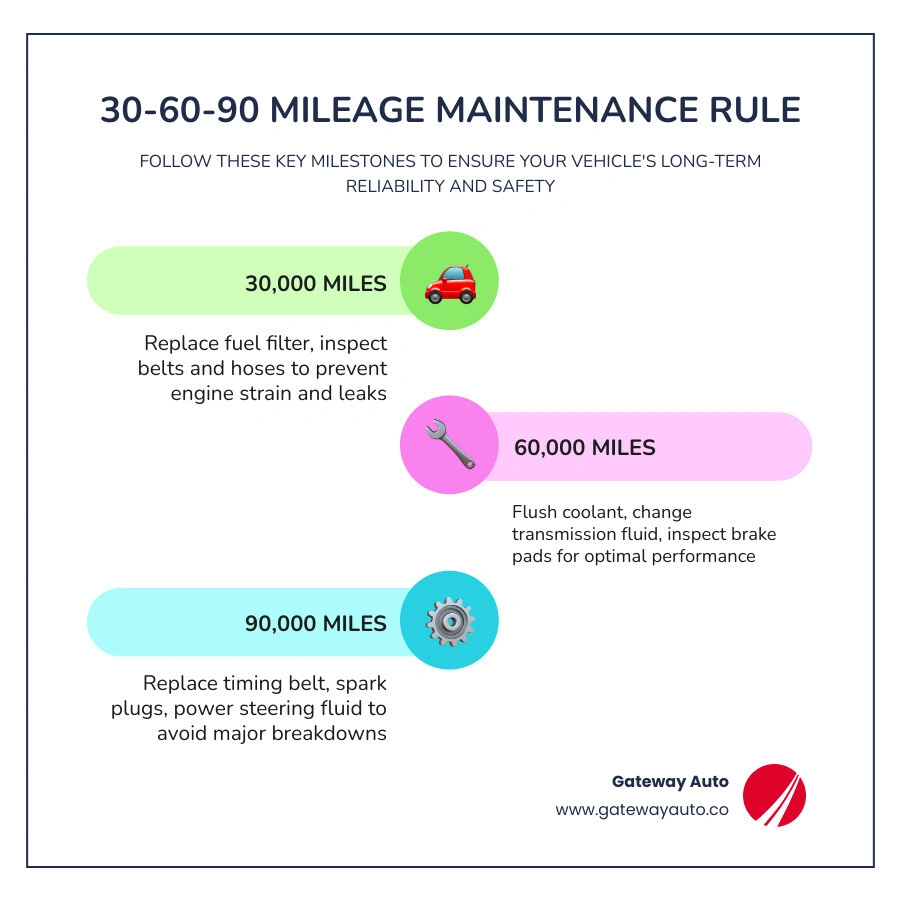
Mastering Your car maintenance schedule: The 30-60-90 Rule
When you look at your owner's manual, you’ll likely see a recurring theme: the numbers 30, 60, and 90. This isn't a coincidence. Most manufacturers design their vehicles to undergo major system checks at these 30,000-mile intervals. Think of it as a "physical" for your car. At Gateway Auto, we see these milestones as the best opportunity to catch small issues before they become expensive, mid-winter headaches on the Kennedy Freeway.

Following this pattern ensures that items with different lifespans are addressed exactly when they need to be. It moves your vehicle from "reactive" repair (fixing it when it breaks) to "preventative" care (keeping it from breaking in the first place).
Essential Milestones for Your car maintenance schedule
As your car moves through its life, different parts wear out at different rates. Here is what we typically look for at those major milestones:
- 30,000 Miles: This is often the first "major" service. We generally replace the engine air filter and cabin air filter. It’s also a common time to replace the fuel filter to keep your fuel system clean. We perform a deep inspection of all belts and hoses, looking for any early signs of cracking or leaking.
- 60,000 Miles: This is a big one. At this stage, most vehicles need their coolant flushed and replaced. We also look at the transmission fluid and brake pads. If you’ve been driving in Omaha’s stop-and-go traffic, your brake pads might be reaching the end of their life here.
- 90,000 Miles: This milestone often involves the most critical preventative task: the timing belt. If your vehicle uses a timing belt rather than a chain, replacing it now is vital. If a timing belt snaps while you’re driving, it can cause catastrophic engine damage. We also typically replace spark plugs and flush the power steering fluid at this point.
For more details on what your specific vehicle might need, you can explore our page on factory scheduled maintenance.
Routine Fluid and Filter Intervals
While the 30-60-90 rule covers the big stuff, your car maintenance schedule relies heavily on routine fluid changes. Oil is the lifeblood of your engine, but the "every 3,000 miles" rule has changed for many modern cars.
Most vehicles today use synthetic motor oil, which can safely last between 5,000 and 10,000 miles. However, if you have an older vehicle or use conventional oil, sticking closer to that 3,000 to 5,000-mile range is safer. We’ve put together a guide on how often to change oil to help you find the right balance for your specific engine.
Beyond oil, don't ignore your filters. A clogged engine air filter forces your engine to work harder, hurting your fuel economy. Meanwhile, a dirty cabin air filter is often the culprit behind that "stale" smell when you turn on the AC. According to research on maintenance frequency, staying on top of these small items is the most cost-effective way to maintain long-term vehicle health.
Tire and Battery Health in Your car maintenance schedule
Your tires and battery are the parts of your car that interact most directly with the environment. In the Omaha and La Vista area, our extreme temperature swings are particularly hard on these components.
- Tire Rotations: We recommend rotating your tires every 6,000 to 8,000 miles. This ensures even tread wear, which extends the life of the tire and keeps your traction consistent. Most tires are designed to last about 50,000 miles, but skipping rotations can cut that life in half.
- Battery Life: Most car batteries last between three and five years. As a battery ages, its ability to hold a charge in extreme cold diminishes. We suggest having your battery voltage tested twice a year once it hits the three-year mark. It’s much better to replace a weak battery in our shop than to find out it's dead in a parking lot during a January blizzard.
For a brand-specific look at these needs, you can also refer to resources like the Chevrolet Vehicle Maintenance Schedule guide.
Adapting to Severe Conditions and Seasonal Needs
Not all miles are created equal. Driving 50 miles on a flat highway is much easier on a car than driving 5 miles through muddy construction zones or hilly terrain. This is why many manufacturers provide two different versions of their car maintenance schedule: Schedule 1 and Schedule 2.

Schedule 1 vs. Schedule 2 Driving Conditions
Schedule 1 is for "normal" conditions—mostly highway driving in temperate weather. However, the reality is that many Omaha drivers actually fall under "Schedule 2" or "Severe" conditions.
Severe conditions include:
- Repeated short trips (less than 5-10 miles).
- Driving in extremely dusty or salty environments.
- Extensive idling (like sitting in school pickup lines or heavy traffic).
- Towing a trailer or carrying heavy loads.
- Driving in extreme heat or sub-zero temperatures.
If your daily commute involves these factors, you should follow a more frequent maintenance interval. This helps prevent the accelerated wear that comes with heavy-duty use. If you’re wondering why this matters so much, we explain it further in our post on why preventive auto maintenance is important.
Seasonal Maintenance for Summer and Winter
In Nebraska, we experience the full spectrum of weather. Your car maintenance schedule should shift slightly with the seasons to keep you safe.
Winter Preparation:
- Antifreeze: Ensure you have a 50/50 mix of antifreeze and water to prevent your engine block from freezing.
- Wipers: Replace blades that are streaking. We often recommend winter-specific blades that can handle heavy snow.
- Tire Pressure: Pressure drops about 1 PSI for every 10-degree drop in temperature. Check your tires frequently when the first cold snap hits.
Summer Preparation:
- AC Inspection: Don't wait for a 95-degree day to find out your AC is blowing warm air.
- Cooling System: High heat puts immense pressure on your radiator and hoses. We check for leaks and "bulging" hoses that might be ready to fail.
Professional Inspections and Long-Term Value
At the end of the day, a car maintenance schedule is about more than just checking boxes; it’s about protecting your investment. When you bring your vehicle to us, you’re getting the expertise of ASE-certified technicians who know exactly what to look for on everything from a 2015 Mazda to a brand-new 2026 model.
Regular maintenance keeps your car safe for your family, ensures you’re getting the best possible gas mileage, and significantly boosts your resale value when it’s time to trade up. At Gateway Auto, we’ve spent two decades building relationships with customers that last for years because we treat every car like it belongs to our own family.
Ready to get your vehicle back on track? Schedule your auto repair service with our team in Omaha or La Vista today. We’ll help you figure out exactly what your car needs to stay on the road for years to come.
Frequently Asked Questions
Can I do some of this maintenance myself?Absolutely. Checking your oil level, topping off washer fluid, and replacing windshield wipers are great DIY tasks for beginners. However, for internal fluid flushes, timing belts, and brake work, we recommend seeing a professional to ensure your warranty remains valid and the job is done safely.
How do I know if I'm a "severe" driver?If most of your trips are under 10 miles, or if you frequently drive in Omaha's stop-and-go traffic during peak hours, you likely qualify for a severe maintenance schedule. This means you should change your oil and rotate your tires more frequently than the "standard" recommendation.
What if I lost my owner's manual?No problem! Most manufacturers now provide digital copies of manuals on their websites. You can also stop by Gateway Auto, and we can look up the specific factory-recommended intervals for your year, make, and model.
Subscribe to Our Newsletter
Get maintenance tips, seasonal reminders, and Gateway Auto news straight to your inbox.
.avif)
%20(3).png)