Paintless Dent Repair: Cheaper Alternatives to Body Shops
What Is Paintless Dent Repair — and Is It Right for Your Car?
Paintless dent repair is a method of removing dents and dings from a vehicle's body panels without sanding, filling, or repainting — preserving the original factory finish completely.
Here's a quick summary of what you need to know:
- What it fixes: Door dings, hail damage, minor creases, and small collision dents where the paint is still intact
- How it works: Technicians use specialized rods and picks to gently massage the metal back into shape from behind the panel
- Cost: Typically a fraction of traditional repair methods — often one-quarter to one-third of the price
- Time: Many repairs take 30 to 60 minutes; hail damage can often be completed in a single day
- When it doesn't work: Cracked or chipped paint, severely stretched metal, sharp-edged dents, or damage near panel edges
Getting a dent is frustrating. Whether it's a parking lot door ding or a hailstorm that hit your whole hood, the first instinct is often to dread the repair bill. The good news is that for a wide range of common dents, there's a faster and more affordable option that most drivers don't know enough about.
I'm Ben Toscano, co-founder of Gateway Auto, and over more than 20 years running a family-owned shop here in Omaha, paintless dent repair has become one of the most valuable services we offer for drivers who want a quality fix without the cost or downtime of a full collision repair visit.
How Paintless Dent Repair Works and What It Fixes
At its core, Paintless dent repair is a craft that relies on the "memory" of your vehicle's metal. Modern vehicles are manufactured with high-strength steel or aluminum panels that are stamped into specific shapes. When a dent occurs, the metal is under tension, but it "wants" to return to its original form.
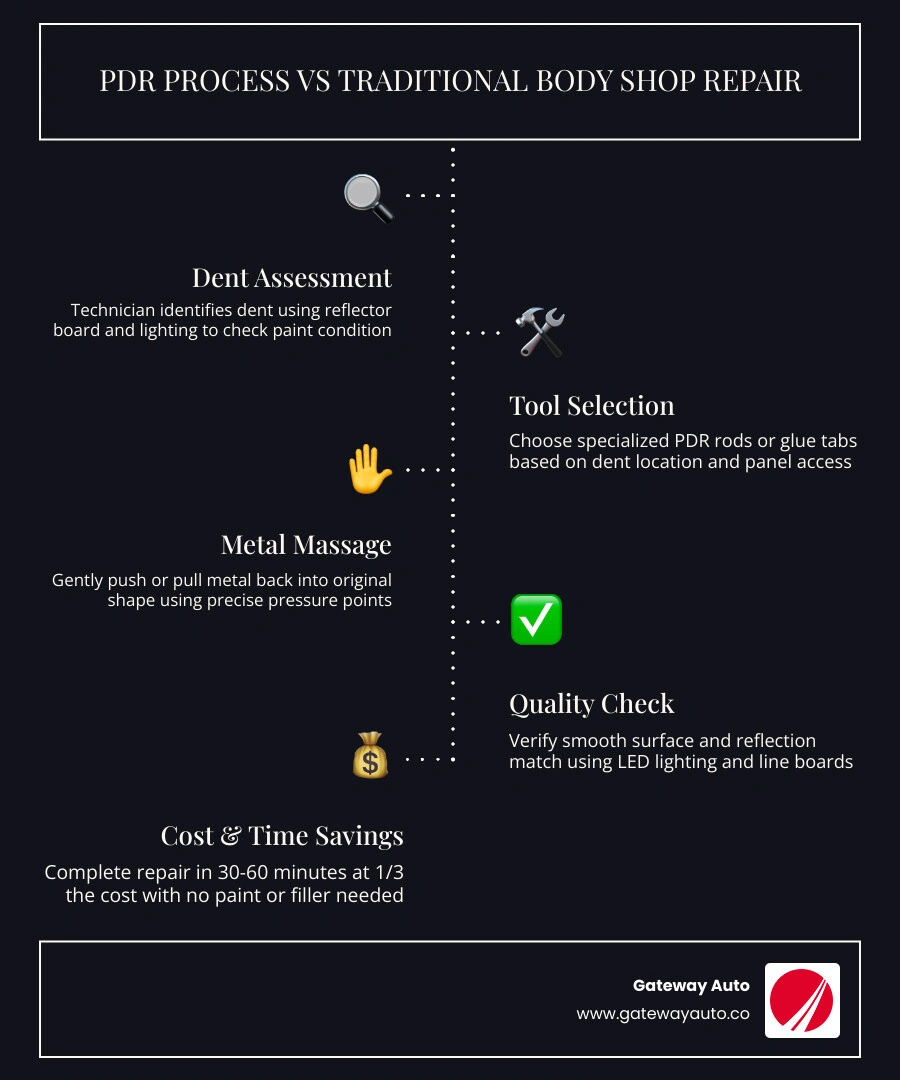
Professional PDR technicians use a variety of specialized tools, ranging from long, thin metal rods to fine-point picks, to reach the underside of the damaged panel. By applying precise pressure to the exact right spots, we can "massage" the metal back into its factory-fresh position.
The Science Behind Paintless Dent Repair
The process is highly technical. Because we aren't using body filler (Bondo) or paint to hide the damage, the metalwork must be perfect. We often use specialized LED lighting or reflector boards to see the "shadows" of the dent, which tells us exactly where the tip of our tool is located behind the panel.
While most repairs involve pushing from the underside, we also use "glue pulling" and tension methods for areas where we can't get behind the metal, such as roof rails or double-walled panels. These modern techniques have advanced significantly, allowing us to repair dents that were once considered "irreparable." To learn more about our specific approach, check out our page on paintless dent repair.
Common Damage Suitable for PDR
Not every dent is a candidate for PDR, but about 95% of minor dents can be successfully repaired this way. Common scenarios include:
- Door Dings: The classic "runaway shopping cart" or "parking lot door swing" damage.
- Hail Damage: This is the gold standard for PDR. Because hail usually leaves many small dents without breaking the paint, PDR is the preferred method for insurance companies and repair facilities alike. You can find more details in our complete guide to hail damage repair.
- Creases: Long, thin dents caused by something sliding across a panel.
- Body Lines: Dents located directly on the sharp "style lines" of a car used to be off-limits, but with modern tools, we can often restore these perfectly.
When Traditional Body Work is Necessary
While we love the efficiency of PDR, it has its limits. If the impact was severe enough to crack, chip, or scrape the paint, PDR alone won't fix it because the metal will still show the paint loss.
Additionally, if the metal is "stretched" — meaning it has been pushed beyond its elastic limit and has nowhere to go — PDR might not be able to return it to a flat surface. Sharp, jagged dents or damage located at the very edge of a panel where the metal is crimped are also better suited for our collision dent repair services.
The Benefits of Choosing Professional PDR in Omaha
Choosing PDR isn't just about saving a few bucks; it's about doing what is best for the long-term health of your vehicle. In a city like Omaha, where we deal with everything from summer hailstorms to tight parking in the Old Market, having a reliable way to keep your car looking new is essential.
According to the NAPDRT, PDR is the only way to repair a dent while keeping the factory paint intact. This is vital because factory paint is applied in a controlled environment and baked at high temperatures that a standard repair facility cannot replicate.
Preserving Your Vehicle’s Value and Factory Finish
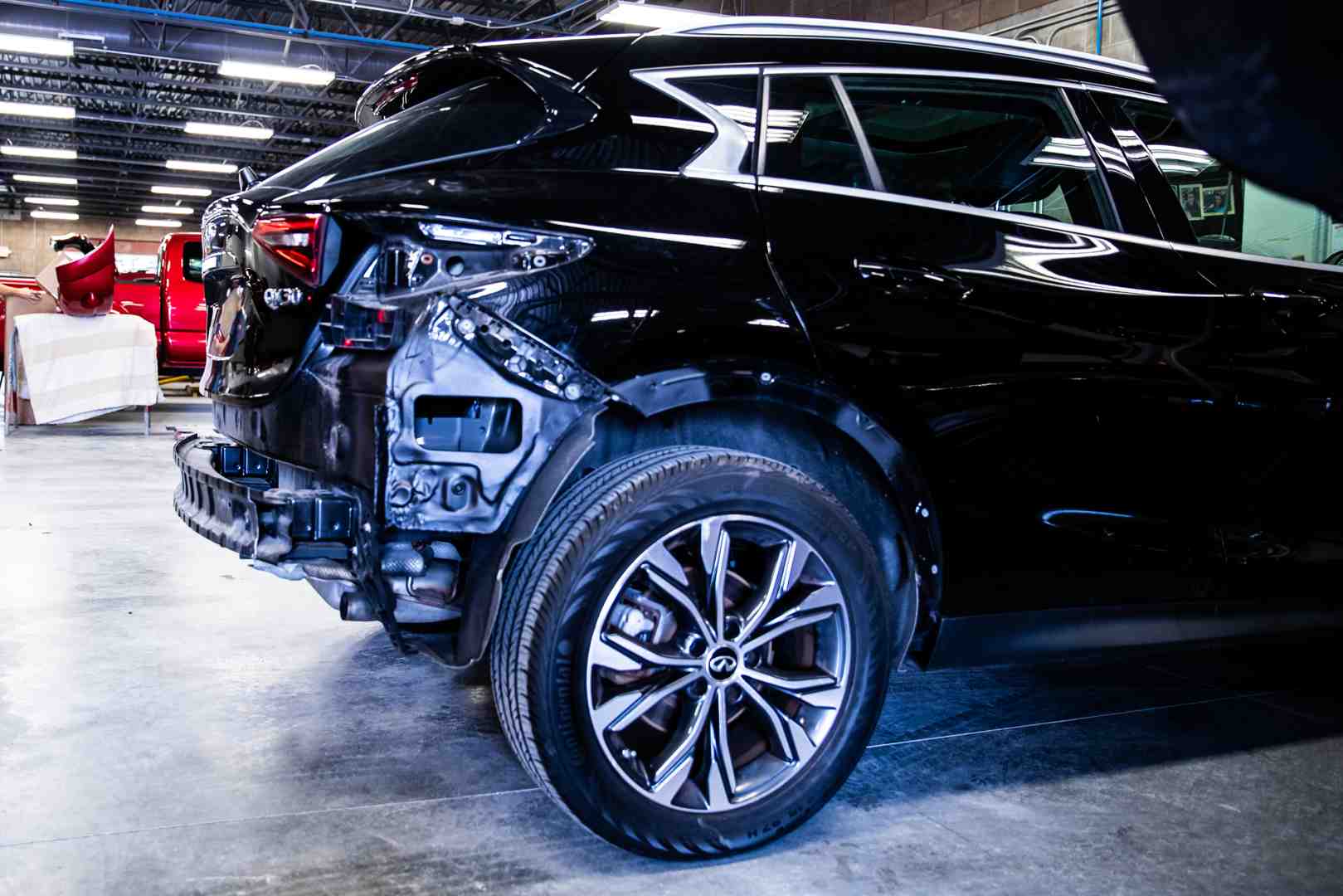
When you use traditional bodywork, you are adding "foreign" materials to your car: body filler, primer, and aftermarket paint. Over time, these materials can shrink or fade differently than the rest of the car.
By choosing PDR, you avoid these issues entirely. Furthermore, because PDR doesn't require repainting, it often doesn't trigger the same "major repair" flags on vehicle history reports that can lead to depreciation. Keeping your original finish is one of the best ways to enhance your car's value after an accident.
Cost and Time Efficiency of Paintless Dent Repair
The most immediate benefit for most of our customers is the savings. Conventional repair methods for a single dent can easily run into the high hundreds or even thousands of dollars because of the labor involved in sanding, painting, and blending adjacent panels.
Paintless dent repair typically costs one-quarter to one-third of what a conventional repair would.
- Time: A door ding can often be fixed in 30 to 60 minutes while you wait.
- Convenience: Instead of leaving your car for three to five days for a paint job, you’re back on the road the same afternoon.
- Deductibles: In many cases, the cost of the PDR repair is actually lower than your insurance deductible, meaning you can avoid a claim altogether. If you're dealing with more than a ding, our minor collision repair guide can help you weigh your options.
Why Professional Expertise Beats DIY Kits
It’s tempting to grab a $20 "dent puller" kit from a big-box store or Amazon. However, we've seen many "DIY" attempts end up costing the owner more money in the long run.
Without the right training, it is incredibly easy to over-pull a dent, creating a "high spot" that is much harder to fix. You can also inadvertently crack your paint by applying too much tension or using the wrong type of glue.
At Gateway Auto, our technicians are I-CAR Gold Class certified. We use professional-grade lighting and specialized tools that allow for microscopic precision. We’ve been serving the Omaha and La Vista areas for over 20 years, and we stand behind our work with a lifetime warranty. For a result that truly looks like the dent never happened, it's always best to schedule a professional paintless dent repair assessment.
Frequently Asked Questions About PDR
Will the dents come back?No. Once the metal is properly massaged back into its original shape, it stays there. The only way a dent "returns" is if the panel is hit again.
Can PDR fix dents on aluminum panels?Yes. Aluminum is more difficult to work with than steel because it is less flexible and has less "memory," but our experienced techs have the specialized tools and heat-application techniques required to safely repair aluminum panels on modern vehicles.
How do I know if my dent is a good candidate?The "eye test" is usually a good start. If the paint is perfectly intact and the dent isn't "sharp" (like a crease made by a knife edge), there is a high probability we can fix it. The best way to be sure is to stop by one of our Omaha-area locations for a quick look.
We take care of people by taking care of their cars. Whether you're dealing with a single annoying ding or a car covered in hail damage, we're here to help you make the decision that's right for your life and your budget. As an all-in-one shop, we can handle the PDR, any mechanical needs, and even insurance coordination all under one trusted roof.