
Stop the Squeal with These Brake Repair Tips
Your Brakes Are Trying to Tell You Something
Knowing the signs you need brake repair could be the difference between a routine service appointment and a serious accident. According to NHTSA data, brake-related issues are a factor in roughly 22% of crashes caused by vehicle component failure — and on wet roads, stopping distances can stretch 30–50% longer than normal. That's a wide margin for error when you're driving through an Omaha winter.
Common signs you need brake repair:
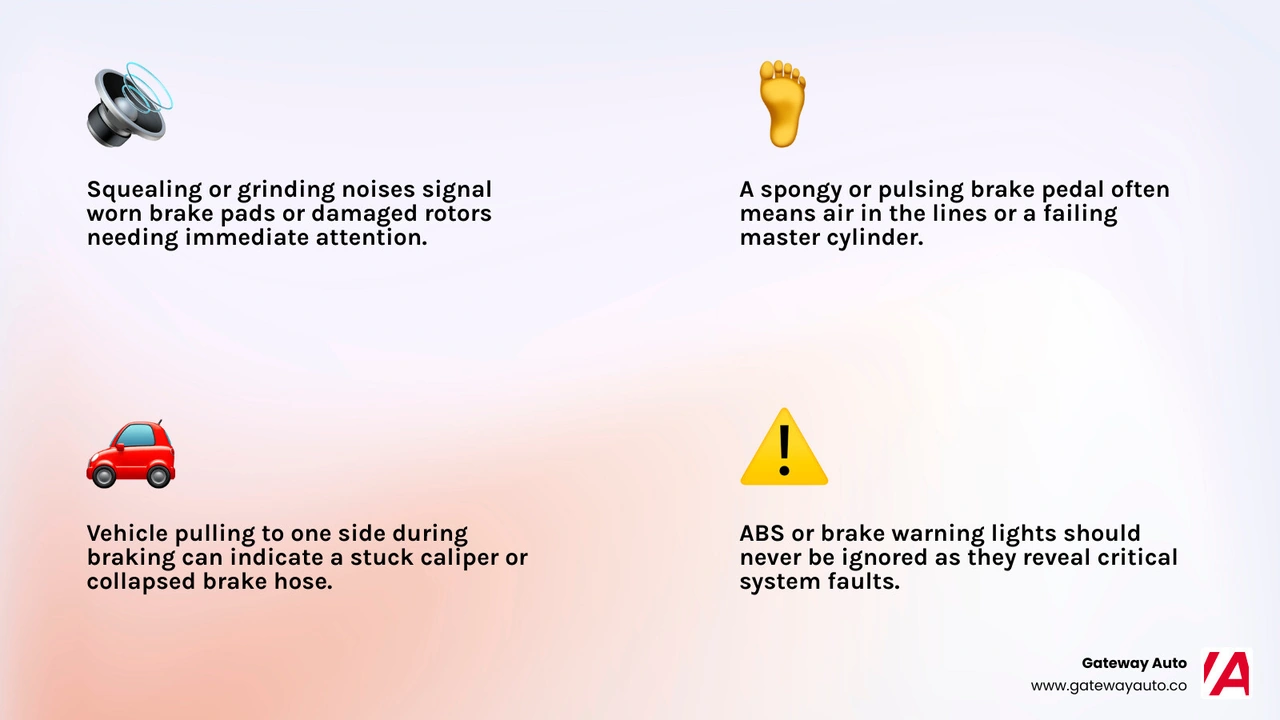
- Squealing or grinding noises when braking
- A soft, spongy, or pulsing brake pedal
- Your car pulls to one side when you slow down
- Longer stopping distances than usual
- A burning smell coming from your wheels
- Visible wear on your brake pads (less than 1/4 inch remaining)
- Your ABS or brake warning light is on
- Brake fluid leaking under the car (clear-yellow, oily fluid)
Most of these signs show up before anything breaks. Your brakes are designed that way — built-in wear indicators exist specifically to warn you while there's still time to act.
I'm Ben Toscano, co-founder of Gateway Auto, and in over 20 years of running a family-owned shop in Omaha, I've seen how quickly ignored brake symptoms turn into expensive repairs — or worse. Recognizing the signs you need brake repair early is the single best thing you can do to protect your family and your wallet.
Key terms for signs you need brake repair:
Clear Signs You Need Brake Repair
Your vehicle is at the foundation of your family's daily life. When something feels off, it is easy to tell yourself you will get it checked "next week." But when it comes to your brakes, waiting rarely saves you money. In fact, active wear does not pause just because the initial symptoms are mild.
If you notice a clear-yellow, oily fluid pooling under your car, you may have a brake fluid leak. Because brake fluid transfers the hydraulic force from your foot to the wheels, a leak is a severe safety hazard that requires immediate attention.
Additionally, if you smell a sharp, burning odor near your wheels, or if your dashboard ABS light illuminates, your braking system is warning you of a critical failure. Driving with compromised brakes is dangerous, and identifying these issues early is key to keeping your vehicle safe. For a deeper look at what to watch for, check out our guide on Brake Repair Omaha and review these 7 Signs Your Car Needs Brake Repair Now, Not Next Week.
Squealing, Grinding, and Clicking: Deciphering Brake Noises
The sounds your brakes make are not random. Modern brake pads are engineered with built-in metal wear indicators. When the friction material wears down to about 2 to 3 millimeters, these small metal tabs begin to scrape against the rotor. This creates a high-pitched squealing or screeching sound whenever you apply the pedal.
If you ignore the squealing, the friction material will eventually wear away entirely. When this happens, you will hear a deep, metallic grinding or growling sound. This means the steel backing plates are rubbing directly against the metal rotors, causing rapid, severe damage to the entire system.
Clicking or rattling noises usually point to loose hardware, such as damaged clips, bolts, or pins that allow the brake pads to move around in the caliper. Just like when you are trying to identify mysterious engine issues, paying attention to these sounds early can save you from a major repair bill. Learn more about diagnosing vehicle sounds in our article Don't Ignore Your Car After Hearing These 7 Engine Noises and see additional tips on the Brake Pad Replacement: 5 Warning Signs & Maintenance Tips | GEICO resource page.
Spongy Pedals and Vibrations: Physical Signs You Need Brake Repair
How the brake pedal feels under your foot tells you a lot about the health of your hydraulic system. A soft or spongy brake pedal usually indicates that air has entered the brake lines, or that the master cylinder is starting to fail. If the pedal sinks all the way to the floorboard with minimal resistance, do not attempt to drive the vehicle — have it towed to a professional shop immediately.
A vibrating or pulsing brake pedal, on the other hand, is usually a sign of warped rotors. When rotors are subjected to extreme heat stress — like during prolonged downhill driving or heavy stop-and-go traffic — the metal can warp.
Sometimes, overheated binding resin from the brake pads gets unevenly distributed across the rotor surface, creating a slick glaze. As the pads press against these uneven surfaces, you will feel a distinct pulsing sensation through the pedal or steering wheel. To understand how these physical sensations relate to your safety, read the 11 Ways To Know You May Need New Brakes | AAA Automotive guide.
Vehicle Pulling and Other Handling Signs You Need Brake Repair
If your car veers or pulls to one side when you apply the brakes, it is rarely a minor alignment issue. This behavior is typically caused by a stuck brake caliper, a collapsed brake hose, or unevenly worn brake pads. When one caliper fails to apply pressure or refuses to release, the vehicle will pull toward the side that is doing the most work.
You may also notice brake fade, which is a temporary reduction in stopping power. This occurs when the braking components become overheated from continuous use and lose their ability to generate friction.
Driving with a car that pulls or takes significantly longer to stop puts unnecessary stress on your steering components, ball joints, and wheel bearings. For more details on handling issues, refer to the guide on 7 Signs Your Car Needs a Brake Repair | Morris Smith Ford of Larned.
How to Visually Inspect Your Brake Pads and Rotors
You do not have to be a professional mechanic to perform a basic visual inspection of your brakes at home. Many modern vehicles have open-wheel designs that allow you to peer through the spokes to see the brake pads and rotors.
Here is how you can check them yourself:
- Look at the pad thickness: Locate the brake caliper and look inside to see the brake pad pressed against the metal rotor. If the friction material is less than 1/4 inch (or roughly 4/32 of an inch) thick, it is time to plan for a replacement.
- Examine the rotors: Check the surface of the metal disc. It should be smooth and relatively even. If you see deep grooves, cracks, or a heavy rust ridge along the outer edge, the rotors likely need to be resurfaced or replaced.
- Check for fluid: Look around the caliper and inner wheel well for any signs of wetness or oily residue, which could indicate a hydraulic leak.
If you want to perform a more thorough inspection, you can jack up your vehicle and remove the wheels. For step-by-step safety instructions, consult the guide on How to Tell If You Need New Brakes: Signs to Look Out For.
Understanding Brake Repair Costs and Lifespan
How long your brakes last depends heavily on your driving habits, your vehicle type, and where you drive. On average, brake pads last between 30,000 and 35,000 miles in urban, stop-and-go conditions. If you do mostly highway driving in light traffic, your brakes could easily last 80,000 miles or more before needing attention.
When it is time for a replacement, the cost typically ranges between $250 and $500 per axle for pads and rotors. Replacing the components on the entire car generally runs between $500 and $1,000.
While it might be tempting to just replace the pads, installing new pads on worn, grooved rotors will quickly ruin your new parts and reduce your stopping power. To help plan your budget, you can read our detailed breakdown of Brake Pad Replacement Cost.
How Often to Inspect Your Brakes and What to Expect
We recommend having your brakes inspected at least once a year, or during every other oil change when your wheels are being rotated. This allows our team to catch minor wear before it turns into a safety hazard or an expensive repair.
At Gateway Auto, we take care of people by taking care of their cars. As a family-owned shop serving the Omaha and La Vista areas for over 20 years, we have built our reputation on honesty and transparency. Our ASE certified technicians perform thorough brake inspections covering your pads, rotors, calipers, lines, and fluid.
Whether you need a simple brake fluid flush or a complete brake system overhaul, we are here to help you make the decision that is right for your life. To learn more about our commitment to quality service, explore our Trusted Auto Repair Omaha Guide, read our Auto Repair Omaha Complete Guide, or schedule an appointment directly through our Gateway Auto Repair Services page.
Subscribe to Our Newsletter
Get maintenance tips, seasonal reminders, and Gateway Auto news straight to your inbox.
.avif)
%20(3).png)