What to Do When a Parking Lot Dent Ruins Your Day
The Modern Approach to Professional Hail Damage Repair
When a storm rolls through Omaha or La Vista, the aftermath can be overwhelming. You walk out to your driveway and see your hood, roof, and trunk lid covered in what look like tiny craters. At Gateway Auto, we’ve seen everything from "pea-sized" pings to damage caused by stones the size of softballs. While the largest hailstone ever recorded in the U.S. was a staggering 8 inches in diameter, most of the damage we see in Nebraska comes from stones around 3/4 of an inch. Even at that size, the impact is enough to stretch metal and crack glass.
The good news is that automotive technology has come a long way. We don't always have to resort to the "sand and spray" methods of the past. Modern hail damage repair focuses on preserving as much of your vehicle's original integrity as possible.
Identifying Different Types of Storm Impact
Not all hail hits the same. Depending on the size of the stones and the wind speed, your car might suffer from several different types of damage:
- Surface Dings: These are the most common. They are shallow indentations where the paint remains perfectly intact.
- Cracked or Chipped Paint: If the hail is sharp or the impact is heavy enough, it can "star" the paint. This is a priority fix because exposed metal will eventually rust in our humid Nebraska summers.
- Glass Damage: It’s not just the metal that suffers. Hail frequently shatters windshields, side mirrors, and sunroofs. If your glass is cracked, it's a safety issue that needs immediate attention.
- Structural and Trim Damage: Severe storms can dent chrome trim, break plastic door handles, or even damage the underlying pillars of the roof.
If you find yourself in the middle of a storm, the best thing you can do is seek shelter under a sturdy roof. Once the storm passes, Nationwide notes that you should photograph the damage from a safe spot and cover any broken windows to prevent water from ruining your interior.
Why Paintless Dent Repair is the Preferred Method for Hail Damage Repair
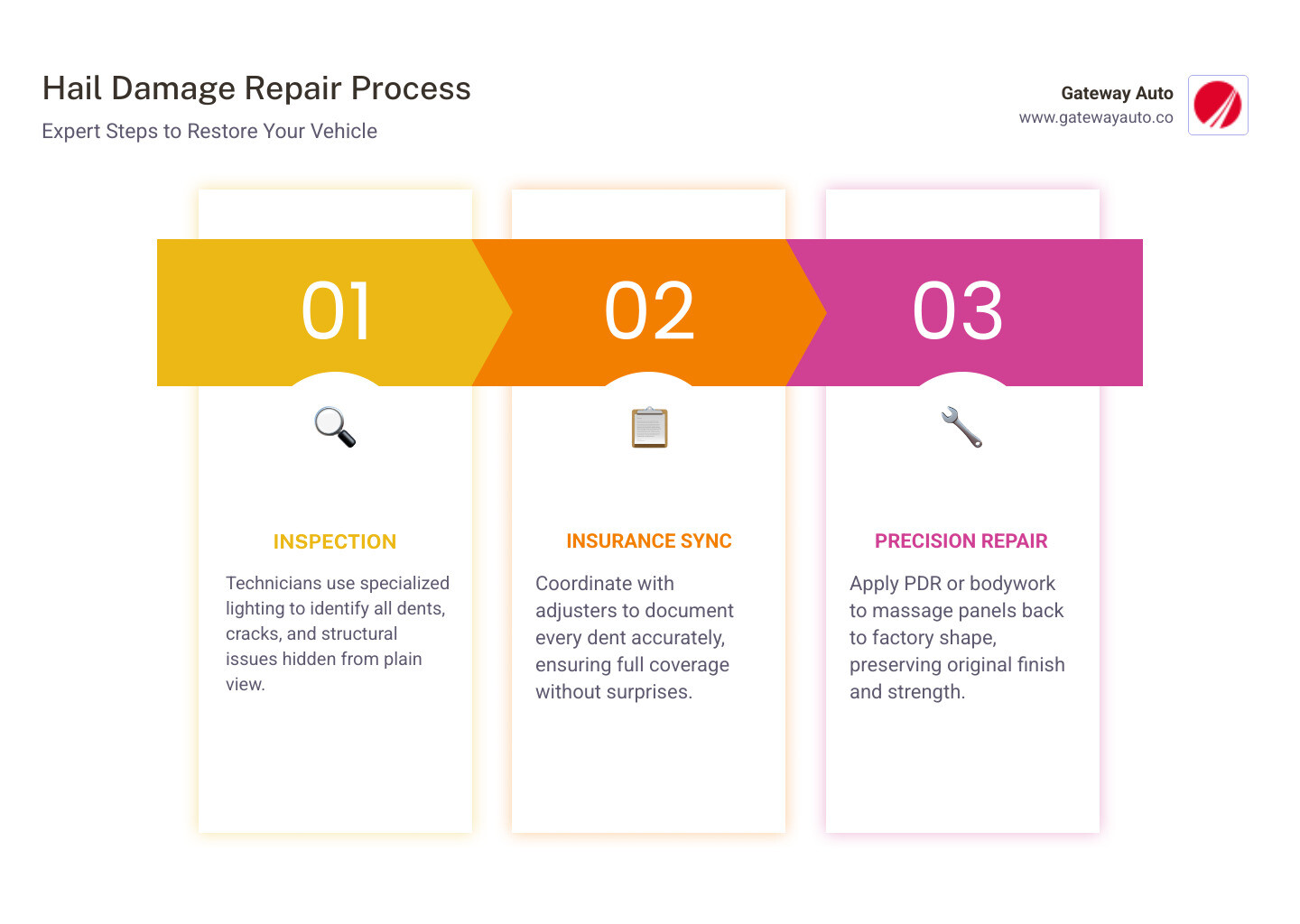
At Gateway Auto, we always look at Paintless Dent Repair (PDR) as the first option. PDR is a specialized technique where our technicians use long, thin metal rods and "whale tails" to reach behind the damaged panel. We then meticulously massage the metal back into its original shape.
There are three major reasons why this is the gold standard for storm damage:
- Preserves the Factory Finish: Your car's original paint is applied in a controlled factory environment and baked on for maximum durability. PDR doesn't require sanding or repainting, keeping that factory seal intact.
- Time Efficiency: While traditional bodywork can take weeks, minor PDR can often be completed in just a few days.
- Value Retention: Because there is no body filler or mismatched paint involved, the repair is virtually undetectable, which helps maintain your car's resale value.
For a deeper dive into how this works in our local shops, check out our Paintless Dent Repair Omaha NE Guide.
When Traditional Bodywork and Painting are Required
As much as we love PDR, it has its limits. If the hail was large enough to stretch the metal beyond its "memory" point, or if the paint is already spider-webbing, we have to move to traditional methods.
In these cases, our I-CAR Gold Class technicians perform auto body painting and restoration. This might involve:
- Sanding and Filling: Using high-quality body filler to level out deep creases.
- Panel Replacement: Sometimes a hood is so badly "peppered" that it is more cost-effective and structurally sound to simply replace the entire panel with an OEM part.
- Professional Refinishing: We use computer-controlled paint matching to ensure the new finish blends perfectly with the rest of your vehicle.
Managing Costs and Insurance for Your Vehicle Restoration

One of the most stressful parts of storm damage isn't the dents—it's the paperwork. Dealing with insurance adjusters and figuring out deductibles can feel like a full-time job. We’ve spent over 20 years building relationships with major carriers, and we’re here to help simplify that process.
What Determines the Final Cost of Hail Damage Repair?
When we provide an estimate, we aren't just counting dents. Several factors go into the "math" of a repair:
- The Number and Size of Dents: A roof with 50 pea-sized dents is a very different job than a roof with 10 baseball-sized craters.
- Panel Material: Many modern vehicles use aluminum panels to save weight. Aluminum is harder to work with than steel because it doesn't have the same "memory," requiring more time and specialized tools.
- Location of Damage: Dents on the "rails" (the structural bars above the doors) are much harder to access than dents on a wide-open hood.
- Parts and Labor: If moldings, mirrors, or glass need to be replaced, those part costs are added to the labor hours.
Generally, you can expect minor PDR to run between $500 and $2,000. Moderate damage usually lands in the $2,000 to $8,000 range. If the damage exceeds $10,000, insurance companies will often look at whether the vehicle is "totaled" based on its current market value. To get a head start, you can use our online estimates tool to send us photos of your damage.
Navigating the Insurance Claims Process
The most important thing to know is that hail damage is covered under the comprehensive portion of your auto insurance policy. Because a hailstorm is considered an "act of nature," filing a claim typically won't cause your insurance rates to spike the way an at-fault accident might.
We work closely with all major providers to ensure your car is returned to pre-storm condition. Whether you need State Farm hail repair or you're filing through Progressive hail repair, our team handles the technical communication with the adjusters. We make sure they see every single dent—even the ones only visible under specialized lighting—so you aren't left with a "partially fixed" car. For more tips on the paperwork side, read our insurance collision repair guide.
Protecting Your Vehicle’s Long-Term Resale Value
A car with visible hail damage can lose 10% to 20% of its value instantly. To a buyer, dents suggest the car wasn't well-maintained, and they’ll worry about hidden issues like rust or weakened structural pillars.
At Gateway Auto, we believe in doing the job right the first time. As an I-CAR Gold Class shop, we follow the highest industry standards for collision repair. We don't just "pop" dents; we restore the integrity of the panel.
When you choose us, you’re getting more than a repair; you’re getting peace of mind. We back all our collision work with a lifetime warranty. If you ever decide to sell your car, having documentation of a professional repair from a trusted local shop like Gateway Auto can actually help prove the vehicle's value to a skeptical buyer.
Common Questions About Hail Repair
- How long will it take? Minor PDR usually takes 1–3 days. If we need to order parts or do traditional paint work, expect 1–2 weeks.
- Will the dents come back? No. Once the metal is massaged back to its original shape through PDR, it stays there.
- Can I just wait until I sell the car to fix it? We don't recommend it. If you get hit by a second storm, the overlapping damage can make PDR impossible, forcing much more expensive traditional repairs later on.
If a Nebraska storm has left your car looking a little rough, don't let it ruin your week. Bring it by one of our locations in Omaha or La Vista. We’ll take a look, talk through your insurance options, and get your car back to looking like it just rolled off the showroom floor.